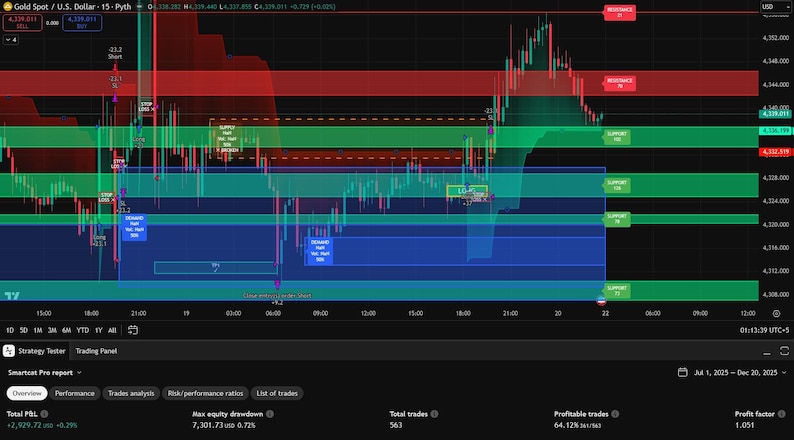
Financial asset returns exhibit an empirical property known as volatility clustering: large price changes tend to be followed by large changes, and small price changes tend to be followed by small changes. In retail trading, indicators that do not adapt to regime transitions generate severe losses during low-volatility compression chop.
By applying neural clustering principles to Normalized True Range (NATR) and standard deviation variance, we can dynamically classify market state into three distinct regimes: Compression, Expansion, and Exhaustion.
The Three Volatility Regimes
- Compression (Chop / Distribution): Variance drops below rolling historical percentiles. All breakout and trend signals are automatically filtered out to prevent whipsaws.
- Expansion (Impulse Wave): Volatility surges above dynamic variance bands with expanding volume. This is the only regime where momentum breakouts and trend-continuation entries are valid.
- Exhaustion (Climax Run): Volatility reaches extreme standard deviations (e.g., >3.0σ) away from the mean. Trailing stops tighten automatically to lock in maximum equity.
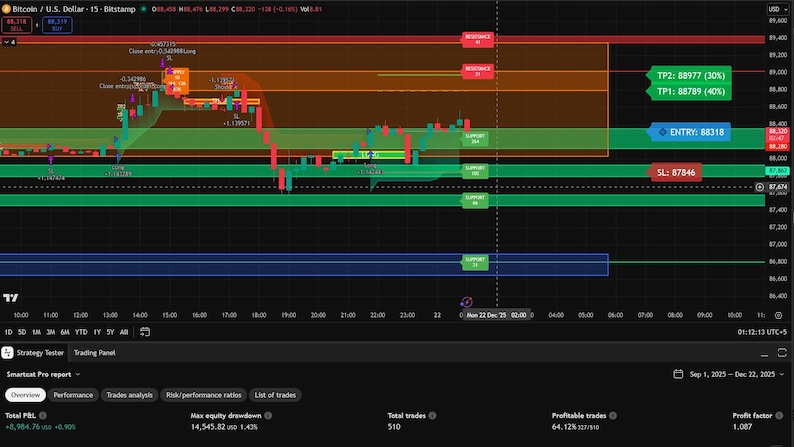
Mathematical Pine Script v6 Architecture
Here is an adaptive volatility filter in Pine Script v6 that calculates a normalized percentile rank of current market dispersion:
Why Fixed ATR Values Fail Across Multiple Assets
A 50-pip ATR on GBPUSD represents entirely different relative volatility compared to a 0 ATR on Bitcoin. Using normalized percentage-based ATR coupled with rolling percentile rankings guarantees that your algorithmic filter remains mathematically invariant across Crypto, Forex, and Equities.
Explore SmartCat Algo's Full Quantitative Engine
Built with institutional noise-filtering, zero-repaint neural clustering, and multi-stage risk management. Own the full Pine Script v6 source code today.
Get SmartCat Algo (8 One-Time)